/
1
2
·
·
Marmalade wars have broken out between England and Scotland over which country invented the breakfast spread so beloved by Paddington Bear and hitherto regarded as quintessentially English.
I was present as one of the judges when the row reached boiling point at the World Marmalade Awards in Cumbria, with two of the judges at odds over its origins in the UK and hundreds of Scottish entries battling it out against English rivals. Sixteen Scottish clans, including eight clan chiefs, have joined the fight to reclaim it as theirs.
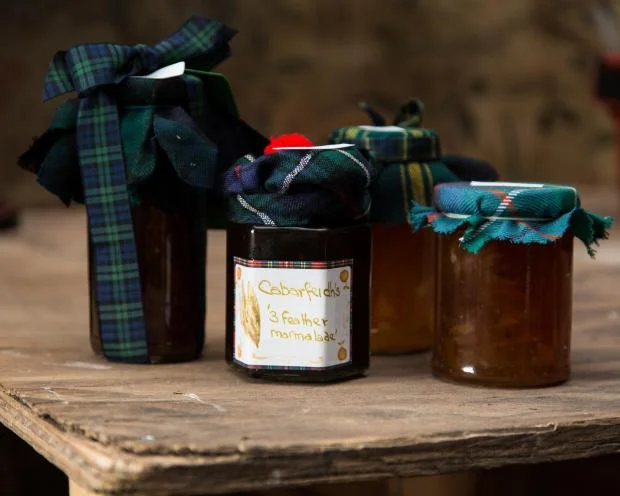
Campbell, Fraser, Forbes, Graham, MacDonald, MacDougall, MacLaren, MacKenzie, Stewart of Appin, MacNeill, Nesbitt, Scott, Graham and Galbraith are among the clans who submitted jars – some decorated in clan tartan Tam O’Shanters and ties – of their homemade marmalade to the new Stirring of the Clans category, introduced last year to acknowledge Scotland’s long history of marmalade making. Scotland also submitted submitted to the McNab category, named after the John Buchan novel, for eating with salmon, grouse or venison. In an unprecedented move, Scots are represented in all categories this year.
English food historians claim England was first to make the preserve which started out in the early 15th century as marmelos, a sugary quince paste imported from Portugal said to have been enjoyed by Henry VIII before 17th century cooks made their own “marmelade”, using squished whole citrus fruit.
But others say it was Mary Queen of Scots who first brought the famous spread to Scotland because when she was seasick on the boat over from France in 1561 she was given some to settle her stomach. It was so effective that she asked for it again when living in Scotland. And so the remedy for "Marie La Malade" became known as marmalade.
The earliest Scottish recipe for orange marmalade by the Countess of Sutherland dates back to 1683. In those days, only the landed gentry could afford the price of imported fruit and sugar. The celebrated Scottish food writer F Marian McNeill, who was active in the Scottish cultural Renaissance, described orange marmalade as “a Scottish invention”.
And for centuries it’s been accepted that Janet Keiller of Dundee was the first to make the marmalade we know today – using a shipload of Seville oranges purchased by her husband at Dundee harbour to make a spreadable Seville orange preserve of shredded peel rather than squished whole fruit pulp – and that the Keiller family was first to produce it on a commercial scale from 1797.
Shirley Spear, a judge on the awards and chair of the Scottish Food Commission, said: “Marmalade as we know it today is certainly Janet Keiller’s invention but there are lots of very ancient Scottish recipes for marmelos. There are many historical crossovers between Scottish and Continental cooking, and our connection with Spain via imported quinces proves that. Scotland has always traded with other parts of Europe and the rest of the world. We have been using citrus fruits for a very, very long time which would indicate that marmalade could have originated in Scotland.”
"There’s no real evidence for all the stuff about Janet Keiller – though I’d get my throat cut if I said that in Dundee"
But the English food historian Ivan Day, also a judge, shredded the idea. “Nonsense,” he said. “Queen Elizabeth and Shakespeare were also enjoying an early form of marmalade at the same time as Mary Queen of Scots. Lots of quince paste was being imported from Portugal and Italy into Britain at that time. So this story has no grounds in reality at all.”
He also put the tin lid on the claim that modern marmalade originated in Dundee.
“There’s no real evidence for all the stuff about Janet Keiller – though I’d get my throat cut if I said that in Dundee. I do get worried when food becomes embalmed in nationalism,” he said.
“Shiploads of bitter Seville oranges had been coming into ports at Leith, London, Liverpool and Bristol since the 13th century.
“By the 1660s there were marmalade recipes not for fruit pastes but for jellies using strips of orange. They were actually apple jellies using citrus peel for flavour and appearance.
“This undermines the rather wonderful story about Janet Keiller, though the family may have been first to acknowledge the potential for mass production of marmalade.
“The only really Scottish thing about marmalade is that the Scots were first to serve it at breakfast in the 18th century. So the iconic British breakfast actually began in Scotland.”
What Paddington Bear would make of that bombshell is anyone’s guess.
* A version of this article first appeared in The Times of London on March 19, 2016